
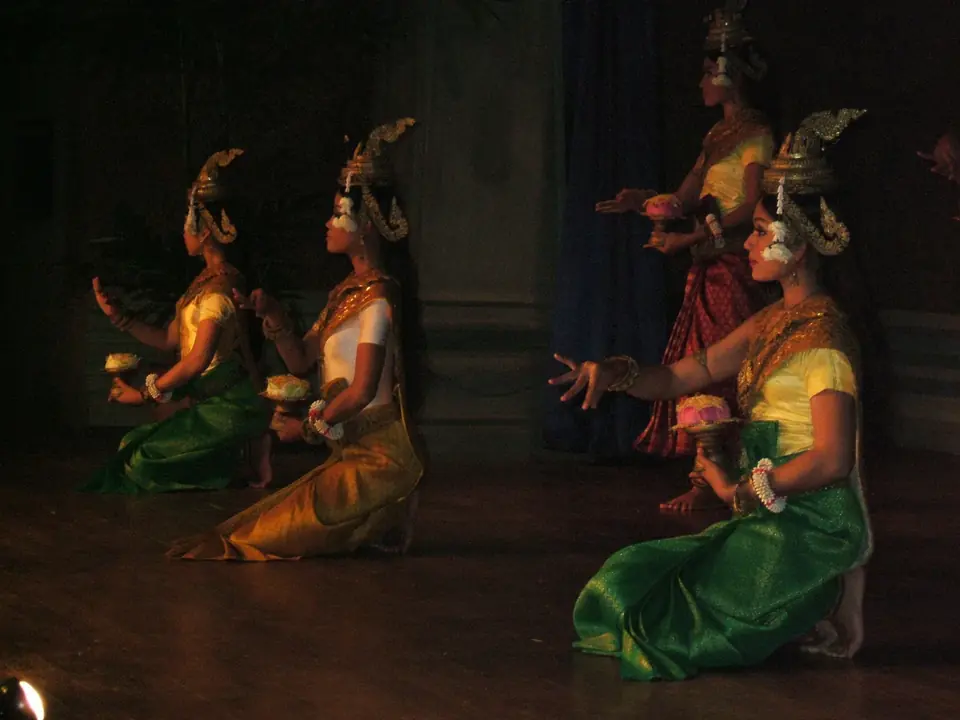
The first impression of an Apsara performance may be the silhouette: a crown, a poised torso and a hand held in an extraordinary curve. Stay with the movement longer and another impression appears—the control required to make each transition look effortless. A little context helps turn an attractive evening photograph into a more attentive encounter with Cambodian performing arts.
Place Apsara within a larger tradition
Apsara dance belongs within the wider world of Khmer classical dance. The Royal Ballet of Cambodia is recognized by UNESCO for its cultural significance, expressive gestures and transmission of knowledge between generations. Not every Cambodian dance, and not every classical role, is an Apsara dance.
The familiar modern Apsara choreography developed in the twentieth century under royal patronage, drawing on the imagery of Angkor. It is better understood as a creative relationship with older heritage than as a performance copied unchanged from a temple wall. Avoid treating every carved figure and every stage character as interchangeable.
Watch a transition, not only a pose
For part of the performance, choose one dancer and follow how a movement begins and finishes. Notice the change of weight, the placement of the foot and the way the hand arrives at a position. Then widen your attention to the group and look at how spacing shapes the stage.
You do not need to decode every gesture immediately. A program note or an introduction from the troupe can help explain the particular piece. Without that context, it is more honest to describe what you observed than to invent a meaning for a hand movement.
Listen as carefully as you look
Let the music guide your attention. Notice whether a movement settles on a musical phrase or seems to continue through it, and how the pace affects your sense of stillness. If musicians are present, spend some time watching their coordination with the performers.
Ask the venue what the program contains. A show advertised with the word “Apsara” may include different types of dance. Knowing the names of the pieces lets you appreciate the variety instead of assuming the whole evening represents one form.
Choose a performance with context
Before booking, look for a clear program, the name of the performing group and practical information about the venue. Ask whether there is an introduction to the repertoire, whether music is live or recorded and what photography rules apply. These questions are more informative than choosing on costume photographs alone.
Consider the setting you prefer. A meal-and-show evening and a theater presentation can offer different viewing conditions. Check your seat’s sightline and the timing of food service if you want to concentrate on the dance. Current schedules and programs should be confirmed directly with the organizer.
Be an attentive audience member
Arrive before the performance starts, silence your phone and keep the screen dim. Follow the venue’s recording rules and avoid flash. Raising a phone for an entire piece can obstruct the person behind you as well as interrupt your own attention.
If a photograph with performers is offered afterward, follow the organizer’s directions. Do not touch costumes or try to bend someone’s fingers into a pose. Ask a question if there is an appropriate opportunity, but remember that performers may need to change, rest or leave.
Continue beyond the evening
When you later visit Angkor, look at how a carved figure occupies space and how an actual dancer uses time. They are different art forms, and the comparison is interesting without insisting they are identical. Reading a troupe’s program or learning a performer’s name can add more to the memory than collecting another anonymous image.
Support the art through legitimate tickets and respectful attention. The people teaching, rehearsing and performing are part of its present, not simply illustrations of Cambodia’s past.
Questions before you go
Is all Khmer dance Apsara dance?
No. Khmer performing arts include multiple classical and other dance forms. Ask which pieces your program presents.
Is Apsara dance an unchanged Angkor-era performance?
The familiar modern choreography developed in the twentieth century, inspired by older imagery and classical traditions.
Sources & further reading
- UNESCO — Royal Ballet of Cambodia
- University of the Arts Helsinki — Cambodian dance in the twentieth century
- Angkor Database — The Royal Ballet in the 1960s
Written with AI assistance and checked against the linked references. This guide does not claim first-hand reporting.